Your context is the moat.
Everyone’s building AI agents right now. New protocols, new orchestration frameworks, new ways to generate things. I’ve built a few autonomous agents with Marketo, and after doing so, I see a pattern worth sharing – especially if you’re evaluating where to invest in AI for your marketing operations.
Autonomous Agents aren’t autonomous
As of March 2026, autonomous agents operate on system prompts – precise instructions written in English. The system prompt defines the agent’s behavior. Someone writes that prompt. At the next abstraction layer, someone writes the prompt for the meta-agent that writes the system prompt.
It’s not brittle. But it’s not truly autonomous either.
When I used n8n to create an AI agent that interacts with Marketo via REST API endpoints, the rule I configured in the system prompt determined everything – what the agent looked at, what it ignored, what it decided. The tool was powerful. The context I gave it made it useful.
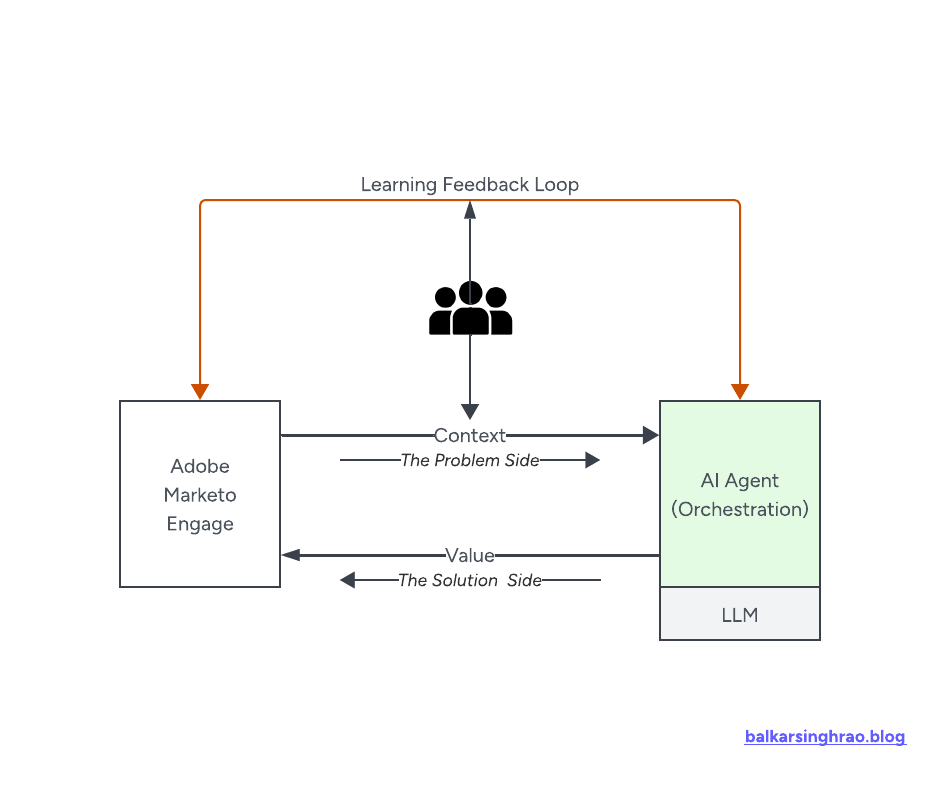
Alex Hormozi once said that if you need to provide a checklist to your team to do the job, you basically have a dumb team. Smarter people just need direction – they have high agency to figure it out. Agentic AI is similar. These agents operate towards achieving a goal. Whatever goal you define for an agent will have an infinite downstream effect. The better you define it, the better the value the agent creates.
This isn’t automation. Smart Lists and Segmentations execute checklists. AI agents interpret context. That’s the difference – and it’s why the person defining the context matters more than the tool. The quality of value on the solution side depends a lot on the quality of context on the problem side. Orchestration is closest to value on the solution side. Context is closest to orchestration on the problem side.
What this looks like in practice
We had a data quality problem in our Marketo instance – a critical field with thousands of inconsistent free-text values. The kind of mess that quietly degrades every campaign that touches it.
Using AI, I reduced those thousands of variations into a clean, standardized set. The process was simple. The impact wasn’t. With clean data in that field, we could immediately sharpen segmentation across dozens of campaigns per month. Relevant messaging improves click-to-open rates. Over time, better targeting means more Marketing Qualified Leads. One cleanup exercise, compounding returns.
That’s what I mean by infinite downstream effect.
The Implication For Buyers
The smartness of AI isn’t useful on its own. The context you pick matters. Why you choose it matters. Why you think the way you think matters. At any abstraction layer – the bias of the person creating the agent shapes the outcome. It’s autonomous, but only at a layer beneath your judgment.
This is why the person configuring your AI layer matters more than the tool itself. The same agent framework, pointed at the wrong problem or given vague context, produces nothing. Pointed at the right problem with domain-specific judgment, it compounds.
If you’re evaluating AI investments for your Marketo operations, the question isn’t which tool – it’s who can embed the right context into the agent.
I’ve spent 12 years inside Marketo – optimizing enterprise instances, building delivery teams, and now using AI to solve data and process problems that Marketo wasn’t designed to handle alone.
 Balkar Singh Rao